

Roof Shingle Calculator
Calculate the number of shingles and bundles needed for your roofing project. Get accurate material estimates based on your roof dimensions and pitch.
Missing Required Information
Please complete all required fields to calculate.
Result
No calculation yet
Enter your roof dimensions and pitch to calculate shingle requirements.
What is a Roof Shingle Calculator?
A roof shingle calculator is an essential tool for homeowners and contractors planning roofing projects. It helps you determine exactly how many shingles and bundles you'll need to cover your roof completely, taking into account your roof's dimensions, pitch, and the specific type of shingles you're using.
Calculating shingle requirements manually can be tricky because you need to account for the roof's slope, which increases the actual surface area compared to the flat footprint. Our calculator handles all these complex calculations automatically, giving you accurate material estimates that help prevent costly shortages or wasteful over-ordering.
Whether you're replacing a few damaged sections or installing a completely new roof, knowing your exact shingle needs helps you budget accurately, order the right amount of materials, and plan your project timeline effectively. This calculator uses industry-standard formulas to ensure your estimates are reliable and professional-grade.
How to Calculate Roof Shingles
Calculating roof shingles involves several steps that account for your roof's geometry and the shingle coverage. Here's how the process works:
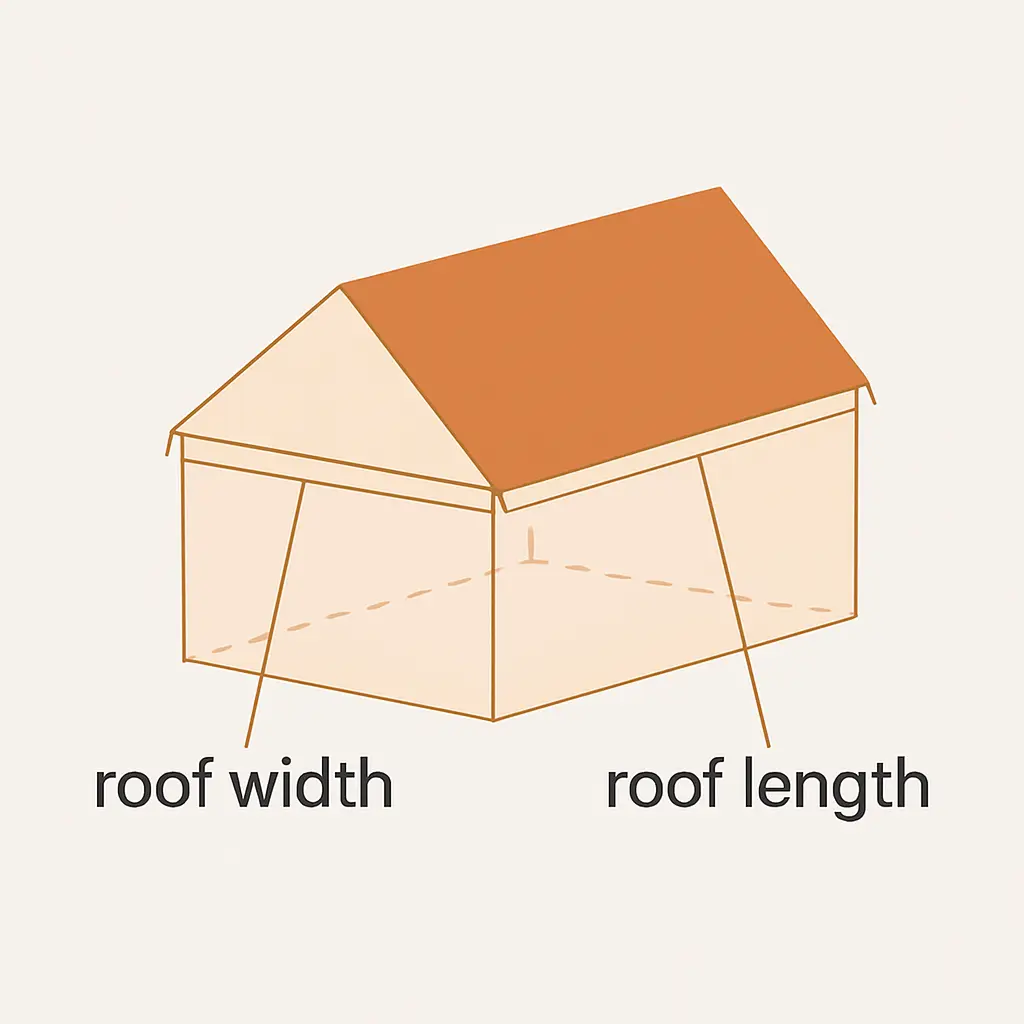
First, you calculate the footprint area, which is simply the length multiplied by the width of your roof. This gives you the flat area that your roof covers. However, since most roofs are sloped, the actual surface area is larger than this footprint.
Footprint Area = Roof Length × Roof Width
To get the actual roof area, you multiply the footprint by a roof pitch multiplier. This multiplier accounts for how steep your roof is - steeper roofs have larger multipliers because they have more surface area. The multiplier is calculated using the Pythagorean theorem based on your roof pitch in x:12 format.
Roof Area = Footprint Area × Roof Pitch Multiplier
Multiplier = √(1 + (x/12)²)
Once you have the roof area, you convert it to squares (1 square = 100 square feet) and then calculate bundles. Most standard shingle bundles cover about 33.3 square feet, which is one-third of a square. So you typically need 3 bundles per square.
Shingle Bundles = (Roof Area ÷ 100) × 3
Finally, to find the total number of individual shingles, multiply the number of bundles by the bundle size (typically 29 shingles per bundle). Our calculator handles all these calculations automatically, so you get accurate results instantly.
Understanding Roof Pitch
Roof pitch is one of the most important factors in calculating shingle requirements. It describes how steep your roof is and directly affects how much surface area needs to be covered. Pitch is typically expressed in the x:12 format, where x represents how many inches the roof rises vertically for every 12 inches of horizontal run.
Common roof pitches range from 2:12 (very shallow, almost flat) to 12:12 (very steep, 45-degree angle). A 4:12 pitch means the roof rises 4 inches for every 12 inches of horizontal distance. Steeper roofs require more shingles because they have more surface area, even though they cover the same footprint.
Common Roof Pitches
- • 2:12 to 4:12: Low slope - used for modern or flat-style homes
- • 4:12 to 6:12: Moderate slope - most common in residential construction
- • 6:12 to 9:12: Steep slope - traditional and classic home styles
- • 9:12 to 12:12: Very steep - found in older homes and certain architectural styles
You can also express roof pitch as a percentage (slope) or in degrees (angle). Our calculator automatically converts between these formats, so you can use whichever measurement you're most comfortable with. If you know your roof's angle in degrees, just check the alternative input option and enter it directly.
Understanding your roof pitch is crucial because it affects not just material quantity, but also installation complexity, safety requirements, and sometimes even the type of shingles that can be used. Steeper roofs may require special installation techniques or additional safety equipment.
Types of Roof Shingles
Different types of shingles have varying coverage areas, durability, and installation requirements. Understanding these differences helps you choose the right shingles and calculate quantities accurately.
Asphalt Shingles
The most common and affordable option, asphalt shingles are available in 3-tab and architectural styles. They typically cover 33.3 square feet per bundle and come in bundles of 29 shingles. Great for most residential applications with a lifespan of 15-30 years.
- ✓ Affordable and widely available
- ✓ Easy to install
- ✓ Good weather resistance
- ✓ Variety of colors and styles
Architectural Shingles
Premium asphalt shingles with a dimensional appearance that mimics wood or slate. Usually thicker and heavier than standard 3-tab shingles, with similar coverage per bundle. They offer better durability and a more premium look.
- ✓ Enhanced aesthetics
- ✓ Better wind resistance
- ✓ Longer warranty periods
- ✓ Higher resale value
Wood Shingles
Traditional cedar or redwood shingles provide natural beauty and excellent insulation. Coverage varies by manufacturer, typically around 32-33 square feet per bundle. They require more maintenance but offer exceptional longevity when properly maintained.
- ✓ Natural, rustic appearance
- ✓ Excellent insulation properties
- ✓ Environmentally friendly
- ✓ Long lifespan with maintenance
Slate and Tile Shingles
Premium materials with exceptional durability and distinctive appearance. Coverage varies significantly by type and manufacturer. These are much heavier and may require structural reinforcement. They're typically sold individually or in smaller bundles.
- ✓ Extremely long-lasting (50+ years)
- ✓ Fire-resistant
- ✓ Unique aesthetic appeal
- ✓ Higher initial investment
Tips for Accurate Shingle Estimation
Measure Carefully
Take precise measurements of your roof length and width. Measure from edge to edge, and account for any overhangs or eaves. If your roof has multiple sections, measure each section separately and add them together.
Verify Your Roof Pitch
If you're unsure about your roof pitch, you can measure it using a level and measuring tape. Place a level on the roof, measure 12 inches horizontally, then measure the vertical rise. This gives you the x:12 pitch ratio.
Account for Complex Roofs
Roofs with multiple sections, valleys, dormers, or hips require more shingles due to cutting and waste. Complex roofs may need 10-15% more material than simple gable roofs. Always order extra bundles for safety.
Check Bundle Coverage
Different shingle types and manufacturers may have slightly different coverage per bundle. Always check the product specifications and adjust the bundle coverage in the calculator if it differs from the standard 33.3 square feet.
Order Extra Material
Always order 10-15% more shingles than calculated to account for cutting waste, mistakes, and future repairs. It's better to have a few extra bundles than to run short mid-installation. Most suppliers allow returns of unopened bundles.
Frequently Asked Questions
How many shingles are in a bundle?
Standard asphalt shingle bundles typically contain 29 shingles, though this can vary slightly by manufacturer and shingle type. Each bundle usually covers about 33.3 square feet, which is one-third of a roofing square (100 square feet). Always check the product specifications to confirm bundle size and coverage.
How many shingles do I need?
To calculate how many shingles you need, first determine your roof area in square feet (including pitch multiplier), convert to squares (divide by 100), multiply by 3 to get bundles, then multiply bundles by the number of shingles per bundle (typically 29). Our calculator does all this automatically based on your roof dimensions and pitch.
How do I measure a roof for shingles?
Measure the length and width of your roof at ground level or from architectural drawings. Measure from edge to edge, including overhangs. Then determine your roof pitch using a level and measuring tape, or check your building plans. Enter these measurements into the calculator, and it will handle all the complex calculations for you.
What is a square in roofing?
A "square" in roofing terminology equals 100 square feet of roof area. It's a standard unit used in the construction industry. When you calculate your roof area, dividing by 100 gives you the number of squares. Most shingle bundles cover one-third of a square (33.3 square feet), so you typically need 3 bundles per square.
Should I add extra shingles for waste?
Yes, it's highly recommended to order 10-15% more shingles than calculated to account for cutting waste, installation errors, and future repairs. Complex roof designs with valleys, hips, and dormers require more waste allowance. Simple gable roofs need less extra material. Having extra bundles is always better than running short during installation.
Can I use this calculator for different shingle types?
Yes, our calculator is flexible and works with any shingle type. Simply adjust the "Bundle coverage" field to match your specific shingle's coverage area (most shingles are 33.3 square feet per bundle, but some may vary). You can also adjust the "Bundle size" if your shingles come in bundles with a different number of shingles than the standard 29.
Embed Roof Shingle Calculator
Add our roof shingle calculator to your website or blog. Help your visitors calculate shingle requirements for their roofing projects. Perfect for construction websites, DIY resources, and roofing contractor sites.
Embed Code
Related Calculators
Roof Pitch Calculator
Calculate roof pitch, slope, and rafter length
Rafter Length Calculator
Calculate rafter lengths and truss counts
Metal Roof Cost Calculator
Estimate costs for metal roofing projects
Roofing Calculator
Calculate roof area and materials
Birdsmouth Cut Calculator
Calculate birdsmouth cuts for rafters
Gambrel Roof Calculator
Calculate gambrel roof dimensions