

Birdsmouth Cut Calculator
Calculate birdsmouth cut dimensions for roof rafters including heel cut, seat cut, rafter segment dimensions, and minimum depths.
Missing Required Information
Please complete all required fields to calculate.
Results
No calculation yet
Enter values to calculate birdsmouth cut dimensions.
What is a birdsmouth cut?
A birdsmouth cut is a specialized notch made in roof rafters that allows the rafter to sit securely on the wall's top plate while maintaining the proper roof pitch. This cut consists of two essential components: the seat cut and the heel cut.
The seat cut is the horizontal portion of the birdsmouth that rests flat on the wall plate. It provides a stable base for the rafter and transfers the roof load to the wall structure. The heel cut is the vertical cut that aligns with the exterior wall, preventing the rafter from sliding sideways.
When executed correctly, the birdsmouth cut ensures proper weight distribution, structural integrity, and accurate roof alignment—making it one of the most critical cuts in traditional roof framing.
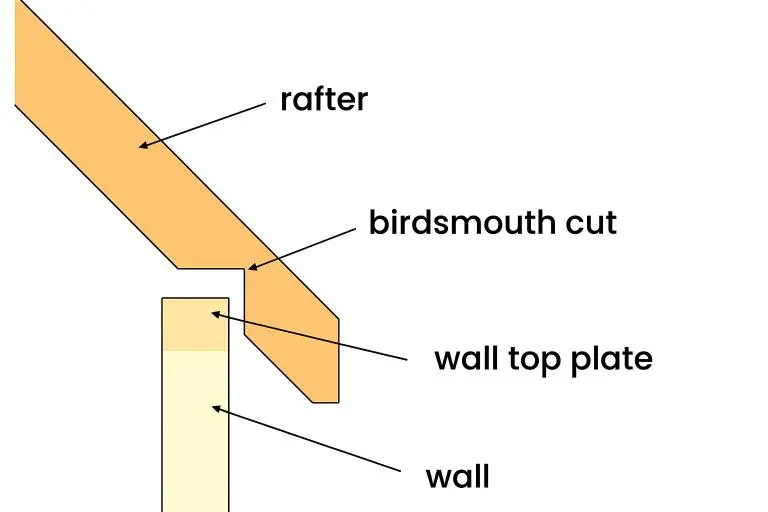
When designing a birdsmouth cut for your roof construction, you'll need to understand various dimensions within the roofing system. These measurements ensure proper structural support and load distribution across your roof.
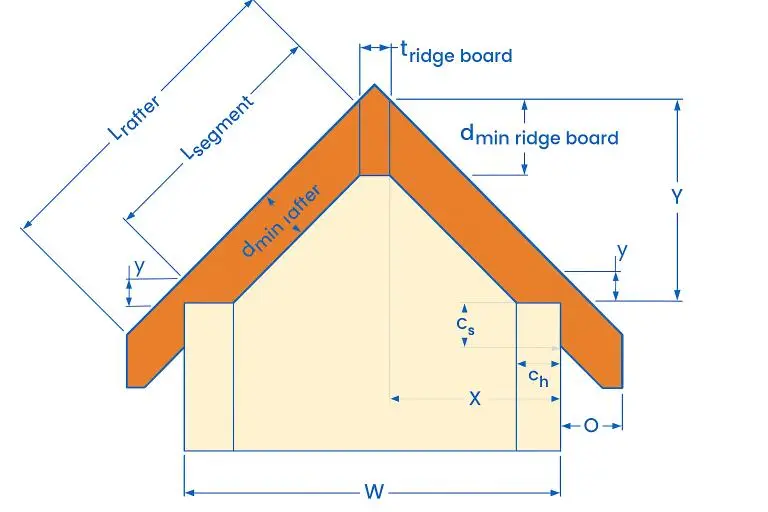
The diagram above shows all the key dimensions involved in creating an accurate birdsmouth cut, including the building width (W), rafter segment measurements (X, Y, Lsegment), the seat cut length (cs), heel cut depth (ch), and the overhang distance (O). Each of these measurements plays a crucial role in ensuring your roof structure is both stable and properly aligned.
How does this birdsmouth cut calculator work?
Our birdsmouth cut calculator uses fundamental trigonometry and structural engineering principles to determine the precise dimensions needed for your rafter cuts. The calculations consider your building width, ridge board thickness, roof pitch angle, seat cut length, and overhang distance.
Simply enter your building dimensions and desired roof pitch. The calculator automatically computes all critical measurements, including the rafter segment dimensions, heel cut depth, minimum rafter depth, minimum ridge board depth, and height above the plate.
Key Calculation Formulas
Rafter Segment Run (X):
X = (W - tridge board) / 2
Rafter Segment Rise (Y):
Y = X × tan(θ)
Rafter Segment Length (Lsegment):
Lsegment = X / cos(θ)
Total Rafter Length (Lrafter):
Lrafter = Lsegment + O / cos(θ)
Heel Cut Depth (ch):
ch = cs × tan(θ)
Minimum Rafter Depth:
dmin rafter = 4 × ch × cos(θ)
Minimum Ridge Board Depth:
dmin ridge board = 4 × ch
Height Above Plate (y):
y = 3 × ch
Why Birdsmouth Cuts Matter
Proper birdsmouth cuts are essential for structural integrity, safety, and long-term durability of your roof framing.
Structural Integrity
- • Distributes roof loads evenly
- • Prevents rafter movement
- • Maintains roof alignment
- • Complies with building codes
Safety Standards
- • Minimizes structural failure risk
- • Meets IRC requirements
- • Supports heavy snow loads
- • Handles wind forces properly
Material Efficiency
- • Reduces material waste
- • Ensures proper lumber sizing
- • Optimizes framing strength
- • Minimizes construction errors
Long-Term Performance
- • Prevents sagging and settling
- • Extends roof lifespan
- • Reduces maintenance needs
- • Protects home value
Building Code Requirements
The International Residential Code (IRC) provides specific guidelines for birdsmouth cuts to ensure structural safety and compliance with building standards.
| Component | Code Requirement | Purpose |
|---|---|---|
| Seat Cut Depth | Maximum 1/3 of rafter width | Prevents structural weakening |
| Minimum Rafter Depth | 4 × heel cut depth | Maintains bending strength |
| Minimum Ridge Board Depth | 4 × heel cut depth | Ensures ridge stability |
| Wall Plate Bearing | At least 1.5 inches | Provides adequate support |
Important: Building codes vary by location. Always consult your local building department and a licensed contractor to ensure compliance with regional requirements before beginning construction.
How to Cut a Birdsmouth
Cutting a birdsmouth requires precision and careful measurement. Follow these steps to create a proper birdsmouth cut for your rafters.
Step 1: Prepare Your Rafter
Mark the top cut first
- 1. Mark the rafter length from our calculations
- 2. From the upper end, draw a line at the roof pitch angle
- 3. Cut along this line using a miter saw or circular saw
- 4. This creates the rafter's peak cut
Step 2: Mark the Birdsmouth Location
Measure from the peak
- 1. Measure the calculated segment length from the peak
- 2. Draw the same angled line at this measurement point
- 3. This marks where the birdsmouth cut begins
Step 3: Create the Heel Cut
Vertical cut alignment
- 1. Measure the heel cut depth from the lower end of the angle line
- 2. Using a speed square, draw a perpendicular line
- 3. Verify this line equals your seat cut length
Step 4: Make the Cuts
Precise execution
- 1. Cut through both marked lines carefully
- 2. Remove the waste material completely
- 3. Test fit on a wall plate to verify dimensions
- 4. The rafter should sit flat and secure
Pro Tip: Always cut your first rafter carefully and use it as a template for the others. This ensures consistency across all rafters and reduces measurement errors.
Common Mistakes to Avoid
Understanding common errors helps you create birdsmouth cuts that are both structurally sound and compliant with building codes.
❌ Overcutting the Seat
Cutting the seat too deep (more than one-third of the rafter width) significantly weakens the rafter. This can lead to structural failure, especially under heavy snow loads or wind forces.
❌ Incorrect Angle Cuts
Using the wrong pitch angle creates gaps between the rafter and wall plate, compromising structural integrity and causing potential leaks at the eaves.
❌ Inconsistent Measurements
Even small variations between rafters create visible sagging, uneven roof lines, and increased load on adjacent rafters.
❌ Insufficient Plate Bearing
Not providing enough contact area on the wall plate reduces load distribution and can cause the plate to crack or the rafter to slip under load.
❌ Ignoring Minimum Depths
Using rafters that are too shallow for the calculated heel cut depth violates building codes and creates serious safety risks.
Frequently Asked Questions
What is the difference between a seat cut and a heel cut?
The seat cut is the horizontal portion of the birdsmouth that rests flat on the wall plate, while the heel cut is the vertical portion that aligns with the exterior wall. Together, they create the distinctive V-shaped notch that gives the birdsmouth its name.
Can I make a birdsmouth cut without a calculator?
While experienced carpenters can calculate birdsmouth dimensions manually using trigonometry, using a calculator ensures accuracy and saves time. For complex roofs or when building codes require specific dimensions, a calculator is essential.
How deep should the seat cut be?
The seat cut depth should not exceed one-third of the rafter's width. This rule prevents weakening the rafter while still providing adequate bearing on the wall plate. Our calculator ensures your seat cut complies with this requirement.
What tools do I need for cutting birdsmouth joints?
You'll need a circular saw or miter saw for the angled cuts, a speed square for marking perpendicular lines, a measuring tape, and a framing square. A hand saw can work for touch-ups, but power tools provide cleaner, more precise cuts.
How do I know if my rafter is deep enough?
The minimum rafter depth equals four times the heel cut depth. Our calculator automatically computes this based on your inputs and roof pitch. Always ensure your actual rafter depth exceeds this minimum requirement.
Can I use the same birdsmouth for all my rafters?
Yes! Once you've calculated and cut your first rafter correctly, use it as a template for all other rafters. This ensures consistency and saves time during construction.
Embed Birdsmouth Cut Calculator
Share this calculator on your website, blog, or construction project documentation.