

Rolling Offset Calculator
Calculate the travel length, run, and true offset for pipe rolling offsets. Perfect for plumbing and piping installations where pipes need to navigate around obstacles.
Missing Required Information
Please complete all required fields to calculate.
Result
No calculation yet
Enter the horizontal and vertical offsets to calculate the rolling offset dimensions.
What is a Rolling Offset?
A rolling offset occurs when you need to connect two sections of pipe that are offset both horizontally and vertically. Unlike a simple offset that moves in only one direction, a rolling offset requires the pipe to navigate around obstacles in two different planes simultaneously.
This situation commonly arises in plumbing and piping installations where pipes must avoid structural elements like beams, columns, or other pipes. The rolling offset allows you to calculate exactly how much pipe you'll need and where to make the bends to successfully connect the two pipe sections.
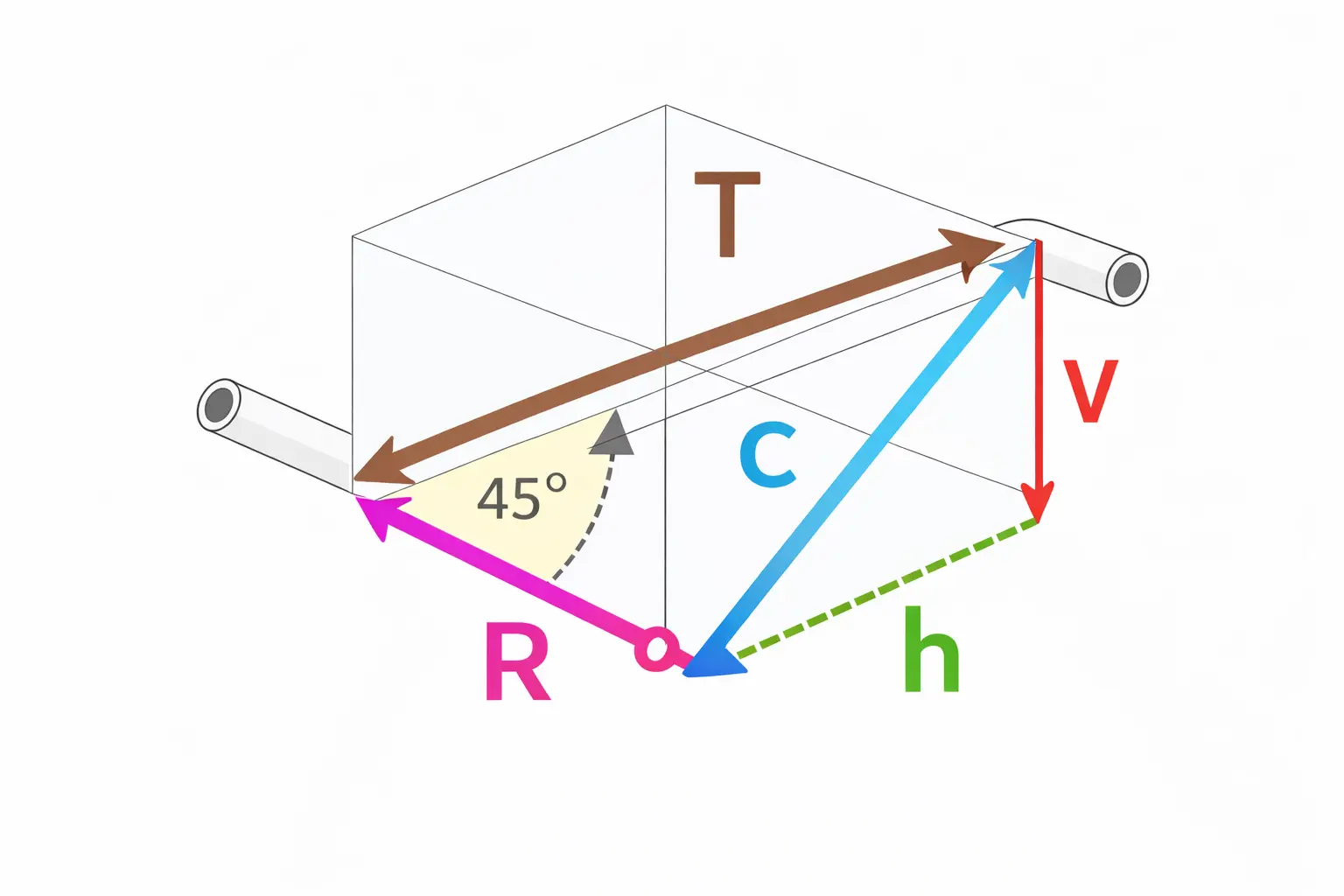
The rolling offset calculation involves finding three key measurements: the true offset (the straight-line distance between the two connection points), the travel length (the actual pipe length needed between the two bend points), and the run (the horizontal component of the travel length).
How to Calculate a Rolling Offset
Calculating a rolling offset requires understanding basic trigonometry and the geometry of right triangles. Here's how the calculation works:
Step 1: Calculate the True Offset
The true offset is the diagonal distance between the two pipe connection points. It's calculated using the Pythagorean theorem:
c = √(h² + v²)
Where:
- c = True offset
- h = Horizontal offset (roll)
- v = Vertical offset (set)
Step 2: Calculate the Travel Length
The travel length is the actual length of pipe needed between the two bend points. It depends on the bend angle of your pipe fitting:
T = c / sin(θ)
Where:
- T = Travel length
- c = True offset
- θ = Bend angle of the fitting
Step 3: Calculate the Run
The run is the horizontal component of the travel length. It can be calculated using either method:
R = √(T² - c²)
or
R = c / tan(θ)
Where:
- R = Run length
- T = Travel length
- c = True offset
- θ = Bend angle of the fitting
Common Fitting Angles and Multipliers
For quick calculations without trigonometry, you can use these multipliers:
| Fitting Bend | Multiplier | Formula |
|---|---|---|
| 22 ½° | 2.6131 | T = 2.6131 × c |
| 45° | 1.4142 | T = 1.4142 × c |
| 60° | 1.1547 | T = 1.1547 × c |
| 90° | 1.0000 | T = 1.0000 × c |
Understanding Rolling Offset Terms
Horizontal Offset (Roll)
The horizontal distance between the two pipe connection points. This is measured perpendicular to the pipe's original direction of travel.
Vertical Offset (Set)
The vertical distance between the two pipe connection points. This represents the height difference the pipe must overcome.
True Offset
The straight-line diagonal distance between the two connection points. Calculated using the Pythagorean theorem from the horizontal and vertical offsets.
Travel Length
The actual length of pipe needed between the two bend points. This accounts for the bend angle of the fitting and is always longer than the true offset.
Run
The horizontal component of the travel length. This represents how far the pipe travels horizontally after accounting for the bend angle.
Fitting Bend Angle
The angle of the pipe fitting or elbow used to create the offset. Common angles include 22.5°, 45°, 60°, and 90°. The bend angle affects the travel length and run calculations.
Practical Applications
Rolling offsets are essential in many piping and plumbing scenarios. Understanding when and how to use them can save time, materials, and ensure proper installation.
Plumbing Installations
- • Connecting water supply lines around structural beams
- • Routing drain pipes past obstacles
- • Installing pipe systems in tight spaces
- • Connecting pipes at different elevations
HVAC Systems
- • Routing ductwork around obstacles
- • Connecting air handling units at different heights
- • Navigating around existing infrastructure
- • Creating efficient airflow paths
Industrial Piping
- • Connecting process pipes around equipment
- • Routing pipes between different floor levels
- • Avoiding interference with other systems
- • Maintaining proper pipe slopes
Construction Planning
- • Estimating pipe lengths needed
- • Determining fitting requirements
- • Planning material purchases
- • Ensuring code compliance
Tips for Rolling Offset Installation
Proper installation of rolling offsets requires careful planning and execution. Here are some essential tips to ensure a successful installation:
Measurement Accuracy
- • Measure horizontal and vertical offsets precisely
- • Use appropriate measuring tools (level, tape measure)
- • Account for pipe diameter when measuring
- • Double-check all measurements before cutting
Fitting Selection
- • Choose the appropriate bend angle for your application
- • 45° fittings are most common and versatile
- • Consider pipe diameter and material
- • Ensure fittings match pipe specifications
Installation Considerations
- • Add extra length for fitting allowances
- • Consider thermal expansion in long runs
- • Ensure proper pipe support and hangers
- • Follow local building codes and regulations
Testing and Verification
- • Dry-fit pipes before final installation
- • Check alignment and clearance
- • Pressure test the completed system
- • Verify proper drainage slopes where applicable
Frequently Asked Questions
What's the difference between a rolling offset and a simple offset?
A simple offset moves the pipe in only one direction (either horizontally or vertically), while a rolling offset moves the pipe in both horizontal and vertical directions simultaneously. Rolling offsets require more complex calculations because they involve three-dimensional geometry.
Can I use any bend angle for a rolling offset?
While you can technically use any bend angle, common angles like 22.5°, 45°, 60°, and 90° are standard because fittings are readily available in these angles. The 45° angle is most commonly used as it provides a good balance between efficiency and available fittings.
Do I need to add extra length for fittings?
Yes, the calculated travel length is the pipe length between bend points. You'll need to account for the fitting allowances (the distance the pipe extends into each fitting) when cutting your pipe. Always dry-fit before making final connections.
What if my offsets are very large?
For very large offsets, you may need multiple fittings and intermediate pipe sections to maintain proper flow characteristics and avoid excessive stress on the pipe system. Consult engineering specifications for large-scale installations.
Does pipe diameter affect the calculation?
The pipe diameter doesn't affect the geometric calculations for travel, run, or true offset. However, larger diameters may require different fitting types, and you should always account for fitting allowances based on your specific pipe and fitting dimensions.
Can I use this calculator for different pipe materials?
Yes, the rolling offset calculations are geometric and apply to any pipe material (PVC, copper, steel, etc.). However, different materials have different fitting types and installation methods, so always follow manufacturer specifications and local codes for your specific application.
Embed Rolling Offset Calculator
Add our rolling offset calculator to your website or blog. Help your visitors calculate pipe offset dimensions for their plumbing and piping projects. Perfect for construction websites, plumbing resources, and DIY guides.